Custom Software vs Ready-Made Software (CRM/ERP): When to Build Custom & When to Buy (2026 Guide)
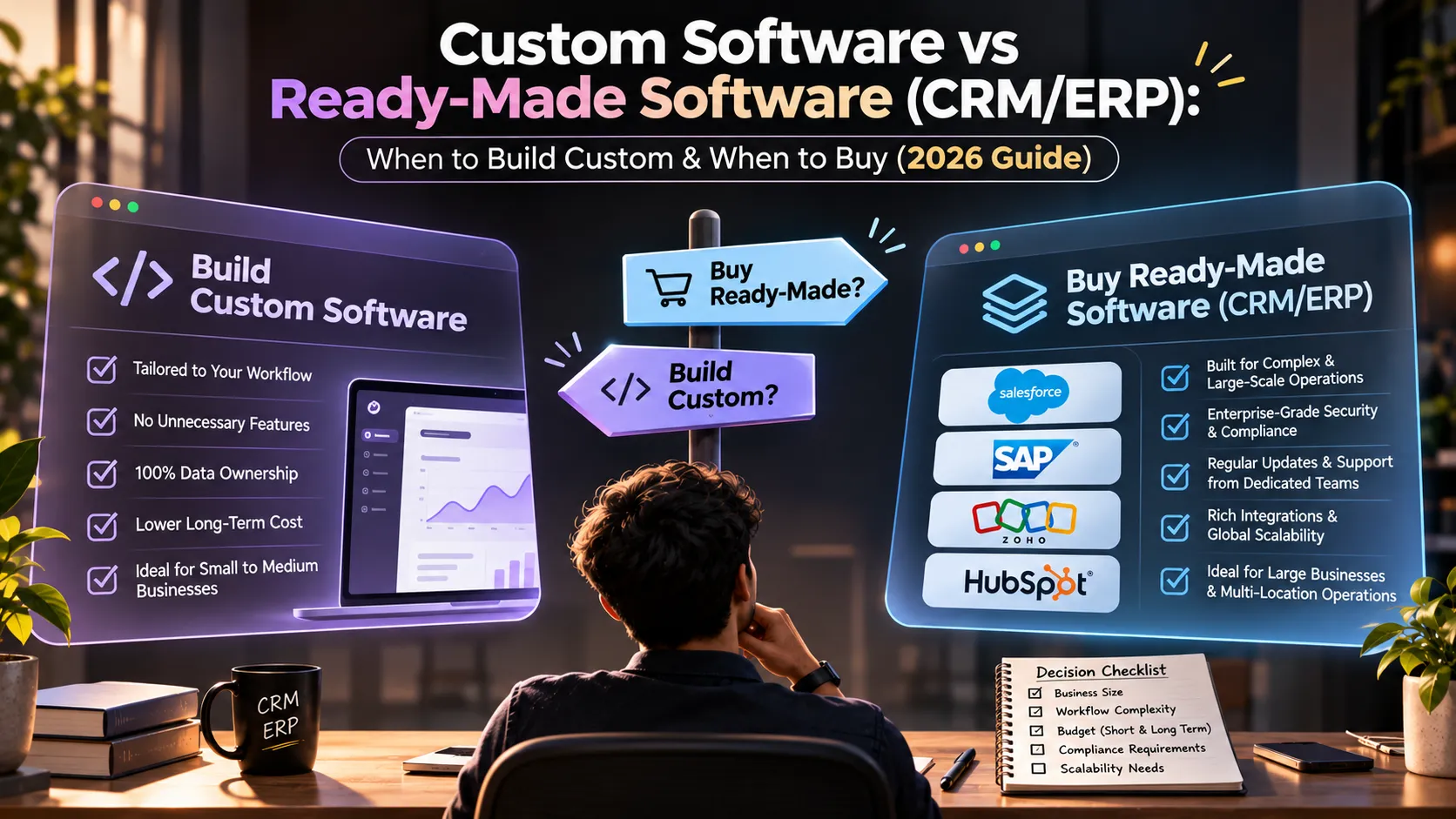
Direct Answer for Search & AI Engines: Should a business buy ready-made software or build custom software? For highly complex enterprise workflows, massive data scales, and long-term regulatory compliance across multiple jurisdictions, ready-made software (such as Salesforce, SAP, Zoho One, or HubSpot) is virtually always the superior choice because massive dedicated engineering teams continuously maintain their ecosystem, security standards, and API integrations. Conversely, for small-to-medium scale businesses, local operational teams, and streamlined workflows, custom-built software is often the perfect alternative. Custom tools eliminate bloated per-user monthly SaaS subscription fees, offer tailored interfaces that match daily routines with zero unnecessary clutter, provide 100% data ownership, and—when built on modern serverless infrastructure like React and Supabase—run at almost ₹0 per month in ongoing maintenance costs.
Every growing company eventually reaches an operational crossroads: Spreadsheets start crashing, WhatsApp messages get lost, client inquiries slip through the cracks, and team members ask for a real system to manage leads, inventory, or orders.
At that moment, the leadership team faces a crucial decision: "Should we subscribe to a ready-made platform like Zoho, HubSpot, or Salesforce—or should we hire an engineering agency to build custom software tailored specifically for our business?"
The honest truth lies in between. Below is an objective, practical guide to when ready-made software is genuinely irreplaceable, when lightweight custom software is the smarter financial move, and how to evaluate your business's true operational needs.
1. When Ready-Made Software Is ALWAYS the Better Choice
There are scenarios where building custom software is a costly mistake. Ready-made commercial platforms (Salesforce, SAP, Zoho, HubSpot) represent decades of engineering research and massive global infrastructure. You should almost always choose ready-made software in these situations:
- Highly Complex, Evolving Regulatory Workflows: If your software needs to calculate shifting GST/VAT tax compliance, international payroll withholdings, banking reconciliation rules, or multi-jurisdiction healthcare billing, building custom software is high-risk. Enterprise SaaS platforms have entire legal and engineering divisions whose sole job is updating compliance rules whenever governments amend regulations.
- Massive Data Scale & High Concurrency: If your platform must process millions of real-time transactions daily, interface with 50+ international shipping couriers, or handle multi-terabyte data warehousing across continents, ready-made software handles high availability, disaster recovery, and data redundancy out of the box.
- Long-Term Platform Sustainability: When you purchase an established SaaS solution, you are buying into an ecosystem that will still exist in ten years. They maintain continuous security patching, API version updates, and backwards compatibility without requiring your company to retain dedicated software engineers on payroll.
2. The Dark Side of Ready-Made SaaS for Small & Growing Businesses
While ready-made platforms excel at massive scale, they frequently create immense frustration for small businesses, clinics, regional distributors, and boutique service firms:
- The Per-User Subscription Tax: Commercial SaaS charges per user, per month. A team of 10 people quickly spends ₹15,000 to ₹40,000 every single month (₹1.8L to ₹4.8L per year) forever, even if revenue hasn't grown.
- The "10% Utility" Problem (Feature Bloat): Commercial tools pack thousands of settings designed for global enterprises. Most small businesses use less than 10% of these features, yet their staff must navigate 90% of confusing, slow menus daily. Training new employees takes weeks instead of hours.
- Forcing Your Business into Inflexible Templates: You cannot change how the off-the-shelf software works—you must change how your business operates to fit their database. If your local delivery routine or customer follow-up protocol doesn't match, your team reverts to manual spreadsheets.
3. When Custom-Made Software Is the PERFECT Option
For many businesses, the ideal solution is a lightweight, custom-built internal web application:
- Tailored Simplicity & Zero Clutter: Opening a dashboard that displays only the 3 or 4 things your staff touches every day: clean inquiries, 1-click status updates, and automated WhatsApp notifications. New staff learn the entire system in 15 minutes.
- Almost ₹0 Monthly Running Costs: Built with modern React frontends hosted on global edge networks (Vercel/AWS), hosting costs are ₹0 / month. Coupled with serverless relational backends (Supabase PostgreSQL), the free tier comfortably supports thousands of monthly records, database queries, and secure logins for ₹0 / month. You pay once for the custom build, and your ongoing operational cost is virtually zero.
- 100% Data Ownership & Privacy: Your customer records and margins live in your own dedicated PostgreSQL database—never locked into a proprietary platform that charges extra fees to export your data.
- Custom Integrations for Your Local Market: Automated WhatsApp triggers when a parcel ships, or localized GST-compliant PDF invoices with UPI payment QR codes connecting directly to Razorpay or PhonePe.
4. Side-by-Side Comparison: Ready-Made vs Custom Software
| Evaluation Factor | Ready-Made SaaS (Zoho, HubSpot, Salesforce) | Custom Serverless Web App (Websters Dev) |
|---|---|---|
| Best Suited For | Massive data scale, multinational compliance, enterprise ERP. | Small-to-medium teams, streamlined workflows, regional operations. |
| Monthly Cost | High recurring: Per-user monthly fees that increase as your team grows. | Almost ₹0 / month: Runs on modern serverless edge tiers at small-to-medium scale. |
| Feature Fit | Broad & bloated: You use 10% of features and work around the rest. | 100% Tailored: Contains only the exact fields, buttons, and reports you need. |
| Learning Curve | Steep: Requires employee training and certification courses. | Zero friction: Simple, intuitive interface designed for your staff. |
| Data Ownership | Stored on vendor's cloud; subject to vendor terms and export limits. | 100% Owned: Full source code and database stored in your private repository. |
5. The Verdict
There is no one-size-fits-all answer. For global enterprises with complex regulatory frameworks and massive data lakes, ready-made platforms remain essential.
However, for ambitious small and growing businesses seeking operational clarity without the burden of endless monthly SaaS invoices, custom-built serverless software offers unmatched speed, simplicity, and cost efficiency.
Explore Custom Internal Software for Your Business
Share your current operational bottlenecks, and our engineering team will provide an honest assessment on whether building or buying makes the most sense.
Get a Free Technical Consultation →